 Gromman Voice
How voice assistants transform healthcare triage
A practical walkthrough of connecting medical call centers to voice AI to automate intake and follow-ups.
Why automate triage now
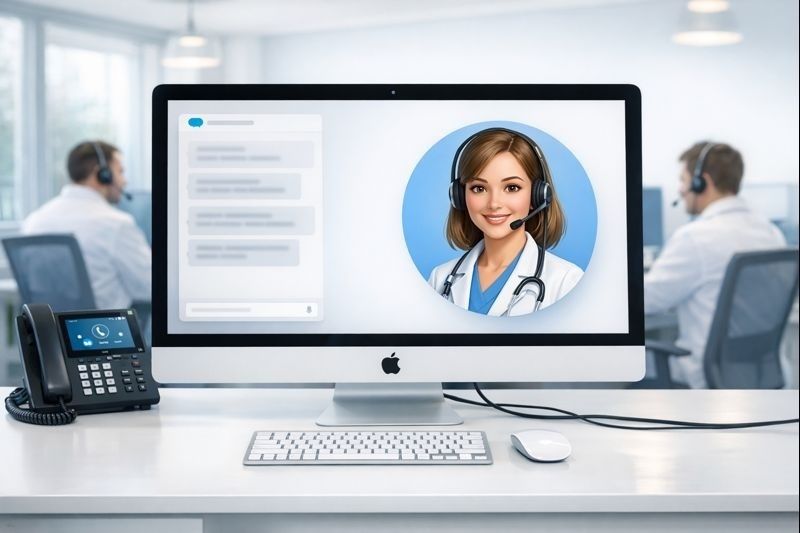
Voice assistants now sit in front of every medical call queue we deploy. They greet the caller within two seconds, capture symptoms in plain language, and sync structured data with the EHR before a nurse even joins. Clinics in Texas, Ontario, and the UAE use the same blueprint to stay HIPAA / PIPEDA compliant while serving bilingual populations.
- Automate intake for triage, prescription refills, billing, and chronic care check‑ins.
- Collect insurance coverage, preferred language, and callback window without keeping patients on hold.
- Push requests into Epic, Athenahealth, Salesforce Health Cloud, or any CRM queue with full context.
Who this is for
- Integrated care networks that coordinate dozens of clinics and specialties.
- Centralized call centers that handle patient intake, refills, and callbacks.
- Telemedicine platforms that must keep multilingual queues open 24/7.
- Hospitals that want HIPAA-grade transcripts, insurance checks, and escalations without adding headcount.
- CX leaders who need auditable automation before scaling other hubs.
Real-world scenario (30 seconds)
A patient calls at 02:17 a.m. complaining about chest tightness. The assistant authenticates the caller, captures symptoms in plain language, switches to Arabic when the patient hesitates, checks insurance eligibility, and pushes a “high-risk” alert to the on-call nurse with transcript, vitals, and the next available slot. By the time the nurse joins, everything needed for charting and escalation is on screen.
Field note from deployments
Every automated triage system we ship is tuned on live medical queues: we stress-test the AI patient intake flow on night volumes, lock down encryption with hospital security, and rehearse escalation with nurse managers. The scenario above is therefore a real playbook, not a lab demo.
The triage bottleneck we see in clinics
| Manual triage | Voice AI triage with Gromman Voice |
|---|---|
| Agents retype symptoms into multiple systems | Assistant writes ICD‑10 friendly notes directly to EHR |
| Long holds during insurance verification | Real-time eligibility check via clearinghouse API |
| Staff must recap call history before escalation | Nurse receives transcript + sentiment score instantly |
| Difficult to serve English + Spanish out of one queue | Multilingual voice models switch languages mid-conversation |
Nurse leads report that 40–55% of daily inquiries fall into predictable flows. Automating these flows frees nurses for escalations while giving compliance teams a clean audit trail of every interaction.
Without vs With Voice Assistant
| Without automation | With Gromman Voice |
|---|---|
| Patients stay on hold while staff toggles between phone, EHR, and clearinghouse portals. | Caller is greeted within two seconds, and structured data flows into the EHR automatically. |
| Night shifts rely on whoever is available; multilingual requests wait until morning. | Voice AI handles English/Spanish/Arabic in the same call, escalating only when high-risk cues appear. |
| Supervisors piece together compliance evidence from notes and recordings. | Every interaction is logged with ICD/SNOMED tags, sentiment, and insurance metadata ready for audit. |
| Marketing and ops get fragmented data, making it hard to prove ROI. | Unified analytics show ASA, deflection, and saved minutes per call per region. |
Blueprint: automated triage workflow
Step 1 – Identify intent and patient record
The assistant authenticates the caller via phone number, date of birth, or patient portal OTP. If the patient is new, the bot creates a provisional record and tags it as “verification required.”
Step 2 – Capture clinical context
Structured follow-up questions surface symptom onset, severity, vitals, medications, and preferred clinician. Responses are mapped to SNOMED/ICD codes so downstream routing is automatic.
Step 3 – Eligibility + scheduling
The workflow calls payer APIs (Availity, Change Healthcare) to confirm coverage, then surfaces available slots from the scheduling system. Patients receive SMS/email confirmation instantly.
Step 4 – Escalation with zero friction
High-risk keywords, abnormal vitals, or negative sentiment trigger an instant warm transfer to the nurse line. The agent screen displays transcript, insurance details, and recommended script.

Integration & compliance stack
- Telephony: Twilio, SIP trunks, Cisco, Five9, or Avaya. We mirror existing IVR menus so no one loses call recording or QA features.
- EHR/CRM: Epic, Athenahealth, Cerner, Salesforce Health Cloud, Microsoft Cloud for Healthcare. Data travels through Gromman Playbooks with field-level encryption.
- Security: HIPAA BAA, HITRUST-ready logging, audit exports to Splunk. Role-based access ensures only clinical staff can review transcripts.
- Localization: English, Spanish, Arabic, French Canadian, and German vocabularies. Pronunciation dictionaries keep drug names accurate.
Need the full list of integrations and deployment models? Scan the healthcare solutions overview to see how each medical call center automation module snaps into place.
KPI cockpit
- Average speed of answer (ASA) — target < 12 seconds even during flu season.
- Percent of intents resolved without a nurse — we see 42–58% on mature deployments.
- Escalation accuracy — monitor false positives/negatives using built-in QA reports.
- Charting time saved per call — typically 1.5–2.3 minutes returned to nurses.
- Patient sentiment — CSAT/NPS captured via SMS or IVR follow-up.
Deployment timeline
| Week | Focus | Owner |
|---|---|---|
| 1 | Intent mapping, compliance review, data sharing agreement | Clinical ops + Legal |
| 2 | Knowledge base build, bilingual prompts, integration sandbox testing | Gromman Voice team |
| 3 | Pilot with one triage queue, QA transcripts, refine escalation rules | Nurse lead |
| 4 | Expand to all lines, train analytics dashboard, review KPIs | Contact center lead |
What you get
- Ready-to-use voice assistant deployed in your cloud or ours, integrated with existing telephony.
- Custom triage workflows that reflect your scripts, risk scores, and escalation rules.
- Multilingual setup for the languages you serve, including pronunciation dictionaries for drugs and doctors.
- Analytics & logging with HIPAA-grade transcripts, insurance events, and sentiment trends.
- Deployment & support from a dedicated team that iterates on prompts, QA, and compliance evidence.
Business impact & geo examples
- Houston primary care network: 52% of English/Spanish calls resolved without RN, wait times dropped from 11 to 4 minutes.
- Toronto chronic care clinic: Automated prescription refills and lab reminders, freeing two FTE schedulers.
- Dubai telemedicine provider: Arabic/English assistant triages Gulf Cooperation Council patients while respecting local data residency laws.
Managers finally see how many requests were resolved automatically per day, while auditors receive complete transcripts tagged with ICD codes.
Ready to modernize triage?
Gromman Voice covers assessment, scheduling, and documentation in one playbook. Explore the full [healthcare solution](/solutions/medical) or contact us to tailor the workflow for your region and regulatory requirements. On the next page you can study ready-made assistants for different clinic formats and choose the one that fits your intake volume.
Frequently asked questions
Is a voice assistant for healthcare only relevant to large hospital systems? No — smaller practices run the same AI patient intake flow on a single line, keeping costs low until volumes spike.
Does the automated triage system replace front-desk staff? It handles repeatable medical call center automation tasks (symptoms, insurance, callbacks) so clinical teams can focus on judgement cases.
How long does deployment take? Typical go-live is four weeks: discovery, knowledge base build, pilot, then scale. Existing Gromman customers can upgrade faster.
Can the multilingual medical voice assistant stay compliant? Yes. Language packs cover English, Spanish, Arabic, and more, while transcripts and media are encrypted and stored in HIPAA/PIPEDA-aligned regions.